World premiere of Tomiris ballet: from folk instruments to 300 Spartans and Rubens
The Astana Opera company presented the national ballet Tomiris, dedicated to the Saka queen, in the capital, NewsAsia.kz reports, citing El.kz.

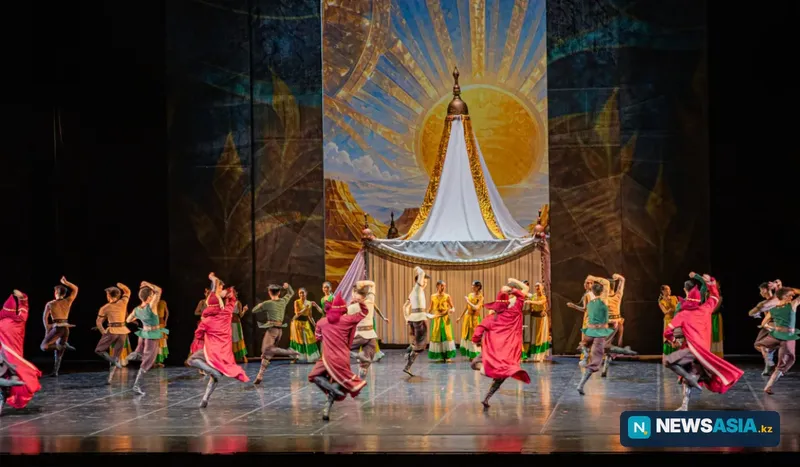
At a press conference held in the capital, the Astana Opera company presented the national ballet Tomiris, dedicated to the Saka queen. Read in a NewsAsia.kz review how this landmark historical production dedicated to the 35th anniversary of the country's Independence came to life and what makes it memorable, the publication reports, citing El.kz news agency.
How the production was staged
The large-scale production will be presented to the audience on November 26-27 on the Main Hall stage of the theater with the support of the Ministry of Culture and Information of the Republic of Kazakhstan. This work is the first full-format national ballet developed entirely in-house by Astana Opera. Modern choreography, Kazakh dance, and classical ballet art are harmoniously combined in the new piece reflecting the spirit of the Great Steppe civilization.
Yermek Amanshayev: history echoing Rubens and the Spartans
The libretto of the production was written by Honored Worker of Kazakhstan, prominent playwright Yermek Amanshayev. More than a year passed since the author conceived and prepared this idea. In his speech, he noted that there is a historical continuity between the era of Tomiris and the events depicted in the widely known film "300".
"Our statehood has a development path spanning centuries. None of this was formed just yesterday or in a short period of time. The Great Steppe has its own great figures. One of the most sacred, most important of these figures is Queen Tomiris," Yermek Amanshayev said.
The playwright recalled that the Saka queen's persona was widely reflected in the history of European art, including the works of Flemish master Rubens.
"The events between Cyrus and Tomiris took place about half a century before the Battle of Thermopylae. Tomiris was a figure who played a very important role in the geopolitics of her era. In our view, she halted Cyrus's campaign toward Hellas for nearly half a century. This indicates how influential a person she was in her time," the libretto author recounted.
"This is respect for history, glorification of our great figures. Their lives show us an example of greatness, of service to the Fatherland. The audience will also see how difficult and complex Tomiris's fate was as a woman. We want to remind people of these values once again," he added.
Sultanbek Gumar: trust in local professionals and folk instruments
For choreographer Sultanbek Gumar, this work marks a major milestone in his creative career, as it is his first two-act ballet. Folk instruments including the dombra, sazsyznai, and sybyzgy are featured in the performance.
"This is a very important production for me. When I received this offer, I was deeply moved. Of course, this is a great responsibility. While previously most of the national ballets in our theater were staged by foreign specialists, this time that duty was entrusted to someone who grew and developed within this theater. Therefore, we tried to fulfill this responsibility at a high level," the choreographer recalled.
"Khamit agha and I worked in the studio day and night. When I danced, Khamit agha translated those movements into music. Initially, our intention was to convey the work through a symphony orchestra. However, since this is a national ballet, we used instruments such as the dombra, sazsyznai, and sybyzgy. They provided immense freedom to convey thoughts through movement," Sultanbek Gumar said.
Khamit Shangaliyev: unity of movement and accent
The author of the ballet's score is Honored Worker of Kazakhstan, well-known composer Khamit Shangaliyev. He placed special focus on the connection between sound and physical movement.
"Everything was thought out meticulously. You will see this for yourselves when you watch the production. The movements are flawlessly set to match every accent and every note in the music. Therefore, this is a very large-scale and painstakingly executed work," Khamit Shangaliyev said.
Altynai Asylmuratova: feeling national culture
Artistic Director of the Astana Opera Ballet Company Altynai Asylmuratova said that having a national product born on their own stage had been a long-standing goal. She noted that the choreographer and the composer had previously worked together successfully on the production of The Seasons.
"This is a large-scale, very important, and long-awaited event. One could even say it was my dream. I wanted the national ballet to be a genuine work of art, not just a performance staged for a report. I dreamed of it being created by people who deeply understand Kazakh culture and have absorbed that culture into their very core. I wanted us to have our own choreographer, our own composer, our own designer. The value of this is very high," Altynai Asylmuratova said.
"They don't just work; they feel the art. At certain points, tears come to your eyes because everything is genuine," the artistic director concluded.
The premiere of the Tomiris ballet once again demonstrated how historical memory and contemporary theater techniques can converge. For some, this production is an opportunity to recall the national chronicle, while for others, it will mark a new milestone in domestic ballet art.



Comments
No comments yet. Be the first.