The Yurt Phenomenon: From Ancient Petroglyphs to Abai's 150th Anniversary
An exploration of the yurt's engineering and deep history within nomadic civilization has been presented. Read the NewsAsia.kz review based on reporting by Aikyn.kz.

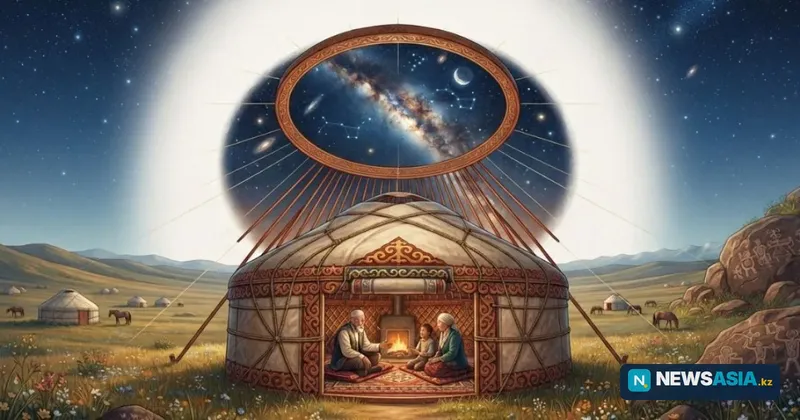
The yurt, the traditional home of nomadic peoples across the Great Steppe, is considered today a unique treasure of human cultural heritage, NewsAsia.kz reports, citing Aikyn.kz. For thousands of years, nomads spanning a vast expanse of 7,500 kilometers from the Khingan Mountains to the Carpathians relied on this portable dwelling designed for constant migration.
Origins and Structural Evolution
The earliest records of the yurt date back to the Bronze Age, around the third millennium BC. This is evidenced by petroglyphs discovered in the Altai Mountains, at the Boyar cliff in Siberia, and on rock art in Crimea, as well as artifacts uncovered in the Pazyryk and Noyon-Uul burial mounds. Historical accounts in the chronicles of the Greek historian Herodotus, Princess Shijun during her visit to the Wusun state, and later travelers including Zemarchus, Plano Carpini, William of Rubruck, and Ibn Battuta documented these grand white pavilions. Notably, not a single iron nail is used in the construction; it is assembled entirely from wood, rawhide straps, horsehair ropes, and felt.
Egeukhan Mukhamadiqyzy: Living in Harmony with Nature
Honored Cultural Worker of Kazakhstan and poet Egeukhan Mukhamadiqyzy believes the greatest advantage of the nomadic dwelling lies in its practical convenience and zero environmental impact.
— No house compares to the Kazakh yurt. When you migrate somewhere, you simply pitch the yurt and settle in. And when you move on, not a trace remains on the ground. Let me give an example: they say 3,000 yurts were raised for Saginay’s memorial feast. More recently, in 1995, during the 150th anniversary of Abai, 1,500 yurts were erected. Those 1,500 yurts covered the entire Zhidebai valley. For three days, festivities, banquets, and aitys competitions took place. A massive crowd gathered. Once the people dispersed and the celebration ended, the yurts were dismantled, loaded onto vehicles, and gone—leaving nothing behind, she recalled.
Ulan Umitkaliyev: The Intersection of Science and Belief
Doctor of Historical Sciences Professor Ulan Umitkaliyev highlights archaeological evidence and the physical properties of the yurt. According to the scholar, findings in East Kazakhstan show that felt-making originated roughly four thousand years ago.
— For instance, during archaeological excavations in East Kazakhstan, felt spread beneath a buried person was uncovered. This proves that felt was already in use about four thousand years ago. Felt is an inseparable element of the nomadic lifestyle. Nomads utilized sheep and horses efficiently in everyday survival. They used horses for travel and transformed sheep wool into felt and essential goods. In addition, Bronze Age tribes on our soil mined ore and engaged in metallurgy. The evolution of these crafts contributed to their transition toward a nomadic way of life, the scholar said.
The historian also emphasized the architecture of the yurt and the profound significance of the shanyrak:
— The shanyrak itself forms a circular crown with crossed struts in the middle. Our ancestors looked at the sun through these crossbars. By observing sunrise and sunset, they kept track of time. They also read signs from the moon. In addition, the shanyrak served as a smoke hole. In general, the shanyrak is a sacred concept for the Kazakh people. The traditional blessing 'May your shanyrak be high' originates from this belief, the expert explained.
According to the scholar, the cornerless round shape is exceptionally efficient at deflecting wind and regulating internal temperature:
— The yurt is thoroughly tailored to nomadic life. Its round, cornerless form helps it withstand strong winds. It also excels at retaining heat. In accordance with the laws of physics, warm air rises. For example, to vent smoke from the hearth, the tundik flap is opened first. Once the coals heat up, the tundik is closed. The rising warm air then spreads evenly throughout the yurt, holding heat inside. Where there is warmth, there is light, and where there is light, good things follow, Ulan Umitkaliyev noted.
Yurt culture demonstrates the multifaceted depth of national traditions. For some, it remains merely a portable shelter of pastoralists, while for others, it represents a miniature model of the cosmos and the universe.



Comments
No comments yet. Be the first.