Severe Pathologies and Vertebral Replacement: Neurosurgeons Detail Unique 3D Implants
Around 50 Kazakhstanis require complete vertebral replacement every year due to severe pathologies, NewsAsia.kz reports, citing 24.kz television channel.

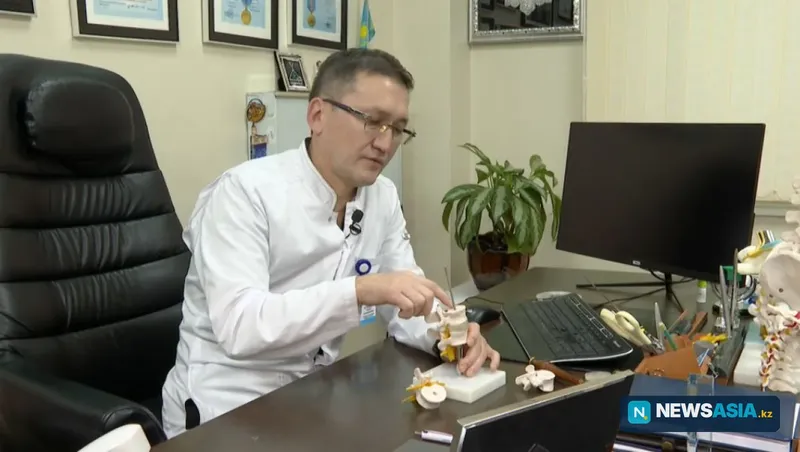
Around 50 Kazakhstanis require complete vertebral replacement every year due to severe pathologies, NewsAsia.kz reports, citing 24.kz television channel.
At the National Center for Neurosurgery, doctors have begun using personalized titanium 3D implants to help such patients. They are designed based on individual anatomical parameters and anticipated mechanical loads. The innovative technology has already been tested on eight patients.
One of them was Kostanay resident Gulsara Askarova. Several years ago, doctors diagnosed her with severe osteoporosis and multiple spinal hemangiomas. Conventional treatments yielded no results, and the patient's condition continued to deteriorate. Specialists at the capital's center performed a complex surgery to insert a custom-designed implant, which allowed the woman to return to a normal life.
Gulsara Askarova described the procedure she underwent:
“It was very difficult, the surgery was complex. Thanks to the doctors of this clinic, I have been walking and living since 2019, and I am very grateful to them. The pain has subsided, although it has not completely disappeared. But the main thing is that I can walk and enjoy life.”
Kazakh neurosurgeons developed this technology jointly with colleagues from Germany. The development process begins with computed tomography and magnetic resonance imaging scans, which are used to construct a three-dimensional model of the spine. Specialists calculate the shape and specifications of the device, after which the implant is 3D-printed from titanium. The entire cycle takes about two weeks.
Talgat Kerimbayev, head of a department at the National Center for Neurosurgery, explained the specifics of the design:
“The implant fully mirrors the contours of the adjacent vertebrae to which it will attach. It is placed between two vertebrae while preserving the spinal cord. The structure is modeled individually, taking into account the anatomical features of each specific patient.”
He also highlighted the extensive trials conducted before introducing the technique into clinical practice:
“The uniqueness of the technology lies in the large-scale scientific and experimental preparation. Together with German scientists, we carried out mathematical modeling of the implant, practiced surgical approaches on anatomical specimens, and tested the structure for durability. In addition, for the first time in the world, we conducted a biomechanical study that made it possible to examine how the implant behaves under standard loads and during movement of the entire spinal column. Only after that did we begin applying the technology in clinical practice.”
Currently, the surgeries are being performed under a scientific research program. However, doctors have already prepared a clinical protocol and plan to make 3D implant placement accessible through the mandatory social health insurance (MSHI) system.


Comments
No comments yet. Be the first.