Ministry Details Adaptation and Breeding Prospects of Released Tigers Umit and Amur
The Ministry of Ecology has commented on the adaptation of tigers Umit and Amur in the wild in Kazakhstan and assessed the likelihood of their encounter, NewsAsia.kz reports, citing Tengrinews.kz.

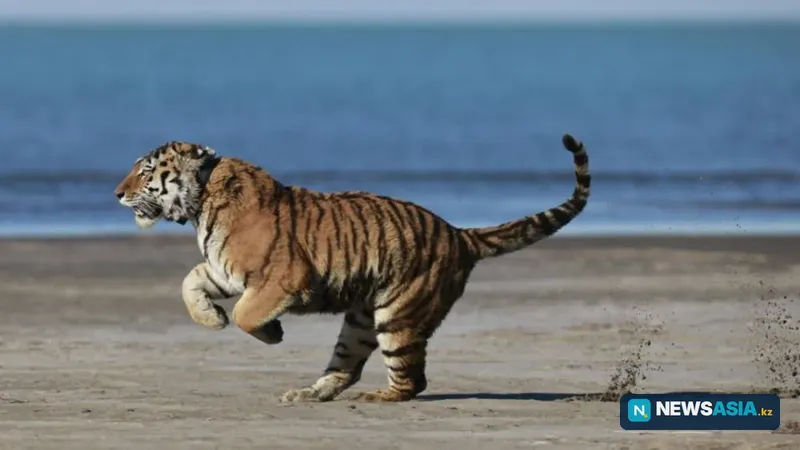
The Ministry of Ecology has commented on the adaptation of tigers Umit and Amur in the wild in Kazakhstan and assessed the likelihood of their encounter, NewsAsia.kz reports, citing Tengrinews.kz. The predators are already hunting on their own, while experts monitor their movements around the clock.
Specialized sensors are being used to track the animals. However, the exact coordinates of the predators are kept confidential for their safety.
"The movements of both tigers are under constant supervision by specialists using GPS collars linked to the Iridium satellite communication system. The data received allows us to track the animals' movements, behavioral characteristics, and territory exploration. For the safety of the tigers, information regarding their exact location is not disclosed," the ministry said.
Experts are studying the animals' movements, but say it is too early to confirm any direct contact between them. The fact that the animals are in adjacent areas does not guarantee they have actually met face-to-face.
"The spatial proximity of the tigers does not by itself indicate direct contact between them. Additional monitoring data is required to confirm an encounter," the ministry explained.
The ministry emphasized that the predators communicate via scent marks, but even this natural behavior does not guarantee immediate contact. Estimating the timing and probability of their meeting in advance is impossible. It is also premature to expect offspring anytime soon: tigers are solitary animals that do not form permanent pairs, and breeding depends on physiology, readiness, food availability, and the degree of adaptation.
The ministry also clarified whether scientists intend to intervene if territorial aggression flares up between the animals or if they ignore each other.
"The core principle of the project is to allow biological processes to occur naturally with minimal human intervention. A lack of interest between the animals, as well as the display of territorial behavior, is not in itself a ground for intervention," the ministry explained.
Humans will intervene only in critical situations:
"Should a threat to the life or health of the animals arise, the necessity of taking additional measures will be determined by specialists based on the specific situation," the ministry said.
To date, both tigers are hunting successfully. The female tiger Umit, released into the Ile-Balkhash Reserve on July 31 and becoming the first tiger to return to Kazakhstan's wild in more than 70 years, has already hunted a wild boar, a wolf, and a Bukhara deer. Amur, who arrived at the reserve later, has also successfully completed two hunts, which scientists confirmed after inspecting the sites of his prolonged stops.


Comments
No comments yet. Be the first.