The 1887 Verny earthquake: From collapsed stoves to new architectural rules
Archival records and scientific research have reconstructed the scale of destruction in Verny following the 1887 disaster, NewsAsia.kz reports, citing El.kz.

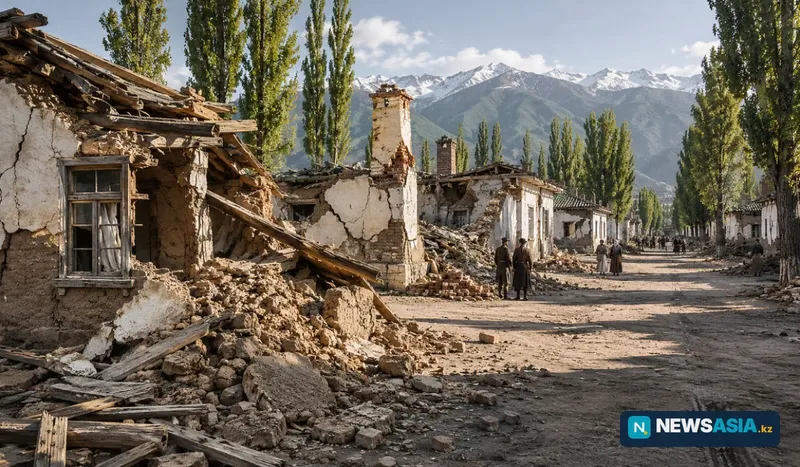
Researchers have pieced together a detailed picture of the 1887 seismic disaster that completely transformed the future city of Almaty, using historical accounts and archival records, NewsAsia.kz reports, citing El.kz. Find out how the disaster reshaped the urban landscape and what lessons were learned in this review by NewsAsia.kz.
Mapping the disaster: eyewitness accounts and science
On the morning of June 9, 1887 (recorded in some historical records as May 28 under the Old Style calendar), Verny was struck by a massive earthquake. Residents felt an initial tremor, and approximately five minutes later, widespread destruction began: ceilings caved in, brick walls and stoves collapsed, and residential neighborhoods were enveloped in a thick cloud of dust.
In the late 19th century, seismic instruments were not yet available in the region, so data was gathered through macroseismic surveys. Researchers relied on newspaper reports, administrative records, photographs, and the findings of a scientific expedition led by geologist Ivan Mushketov. In his fundamental study «The Seismic History of Almaty,» researcher Alkuat Nurmagambetov examined accounts from 104 settlements collected by the expedition and the press, making it possible to estimate the intensity of tremors far beyond the city limits.
A thousand inspected houses and a mosaic of destruction
Inspection records of one thousand homes in Verny, preserved in the Central State Archives of Kazakhstan, along with archival photographs, proved crucial for historians. Specialists mapped the damage data onto a historical city plan, revealing a detailed and varied pattern.
The map demonstrated the uneven nature of the seismic impact: along Verny's southern edge, the intensity was around 8 to 8.5 on the scale, while to the northeast, in the area of the Bolshaya and Malaya Almatinskaya stanitsas, shaking reached 9.5 to 10. Experts note that intensity reflects the severity of effects at a specific location and depends on soil conditions and construction types, unlike magnitude, which measures the total energy released at the epicenter.
Material behavior: stone, clay, and wood
According to Alkuat Nurmagambetov, prior to the catastrophe, the housing stock in Verny and neighboring settlements roughly comprised 1,938 adobe, stone, and brick buildings, alongside 938 wooden houses (fired-brick structures were rare). The researcher stresses, however, that figures in historical sources vary.
The earthquake affected different materials in distinct ways:
- Mudbrick, adobe, and stone buildings suffered severe damage, with many leveled to the ground;
- Fired-brick buildings were also heavily damaged by ground shaking;
- The frames of wooden houses generally withstood the impact, though interior plaster crumbled, and brick partitions, stoves, and chimneys collapsed.
Experience showed that standing exterior walls did not ensure safety: a collapsed heavy chimney or damaged stove posed an immediate threat to human life.
Building codes and debates over the city's future
The catastrophe prompted an overhaul of construction policy. In 1870, city authorities had encouraged adobe construction and restricted wooden buildings to preserve the Tien Shan spruce. After the earthquake, priorities shifted dramatically toward lightweight wooden structures with reinforced joints.
Architects Paul Gourdet and Pavel Zenkov contributed to drafting new standards, with scientific backing from geologist Ivan Mushketov. On November 8, 1888, the Semirechye regional administration approved rules «On the construction of buildings most resistant to the destructive effects of earthquakes based on science and experience» (specialized literature also cites 1889, which may reflect publication stages). Authorities even considered relocating Verny entirely: in June 1887, Governor-General Gerasim Kolpakovsky held official correspondence on whether leaving the city in its current location was advisable.
The tragic experience of Verny demonstrated how differently natural disasters affect the built environment and how historical challenges shape architectural standards. For some specialists, the lessons of 1887 spurred the development of engineering thought, while others saw them as a reminder of how fragile human dwellings remain in the face of nature.



Comments
No comments yet. Be the first.