School Dombra Lessons: From Alphanumeric Notation to Kurmangazy's "Adai"
Special methods for teaching the dombra and a school music repertoire have been introduced at an Astana educational institution, NewsAsia.kz reports, citing Aikyn.kz. Read our review to see how the national instrument lessons are conducted.

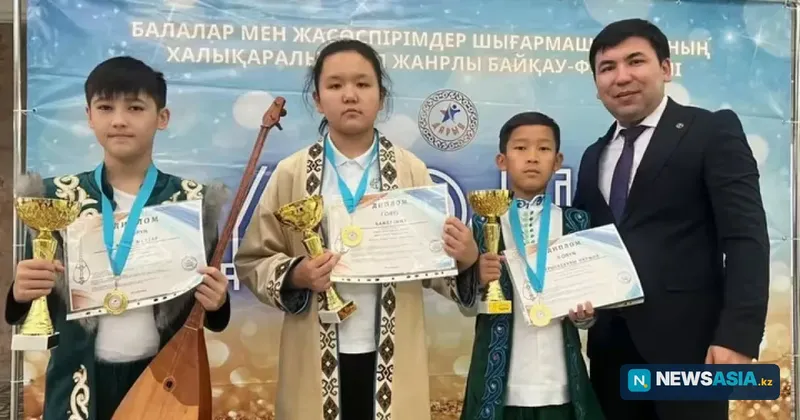
Special methods for teaching the dombra and a school music repertoire have been introduced at an educational institution in Astana, NewsAsia.kz reports, citing Aikyn.kz. Read our review for more details on the importance of integrating the national instrument into the school curriculum and children's enthusiasm for the art.
How the Lessons Are Organized
At Zerdelı School No. 2 in the capital, dombra has been taught as a standalone subject. Currently, dedicated lessons are held twice a week for pupils in grades 1–5. In total, about 260 pupils have taken up learning the native Kazakh instrument. Because pupils attend with their classes, a group teaching method is used. This approach fosters the children's ensemble culture and encourages them to listen to one another.
Aset Kairatuly: A Teacher Promoting National Art
Aset Kairatuly, the school's dombra teacher, holds a master's degree in art history and is a laureate of the Republican Teachers' Competition. He noted that the attitude toward the dombra has changed radically compared to previous years.
— In my opinion, this attitude has changed significantly in recent years. Today, interest in national values and our native art is growing. It is right that the dombra is taught as an independent subject, rather than merely as an extracurricular activity or elective. That is because it helps shape the national identity of the younger generation. The fact that dombra is taught as a separate subject at the Zerdeli school is proof of this. Encouragingly, not only children but also parents show great interest in the dombra. In this era of globalization, when children dedicate so much time to gadgets, seeing them voluntarily play the dombra brings joy to parents as well. After all, the dombra is your history. It is not just a musical instrument; through it, one can understand the nation's past and identity. Therefore, if both the school and parents treat dombra lessons as one of the primary subjects, we have everything to gain and nothing to lose, — he said.
Teaching Methods and Repertoire Selection
Among traditional sheet music, numerical notation, and playing by ear, the teacher found the alphanumeric system to be the most effective for teaching the dombra. Despite ongoing debates among professional musicians regarding the abandonment of numerical notation, the teacher takes a measured approach to the issue.
— I do not look at this issue unilaterally. I believe the numerical system should not be completely rejected. It is right to teach a child studying at a music school using classical musical notation. But in our situation, the alphanumeric system proves effective. For instance, this method is very convenient for a first-grader who is just starting to learn the dombra. They quickly understand which fret to press, which note is located on that fret, and which finger to use. This helps the child achieve their first successes, — Aset Kairatuly said.
The school curriculum ranges from folk songs to classical kuys. First-grade pupils master the songs "Kuttyktaimyn, mama" (Congratulations, Mom), "Biz omirdin gulimiz" (We Are the Flowers of Life), and "Erkem-ai" at the beginning of the year, culminating with the folk kuy "Zhastar bii" (Youth Dance). In grades 2–3, the kuys "Nar agashy", "Tepenkök", "Kelinшек", and A. Sultanbekov's composition "Dombra" are performed, while grades 4–5 cover Kurmangazy's kuys "Balbyrauyn" and "Adai", as well as A. Zheldibayev's work "Erke sylkym". The repertoire also includes the contemporary composition "Er Turan", taught starting from grade 4.
According to the teacher, children frequently suggest playing pieces they see on social media on the dombra, and he consistently supports this interest.
This learning process demonstrated how versatile the teaching of national art in school can be. While for some the dombra is a simple lesson in mastering melody and strumming, for others it has become a way to deeply connect with national identity and ancestral heritage.



Comments
No comments yet. Be the first.