KOBA II Series: From Buying Milk to The Pursuit of Happyness-Style Drama
The second season of the Kazakh crime drama KOBA II premiered on Kinopoisk on November 26. Read about the project and its background in this review by NewsAsia.kz, citing NUR.KZ.

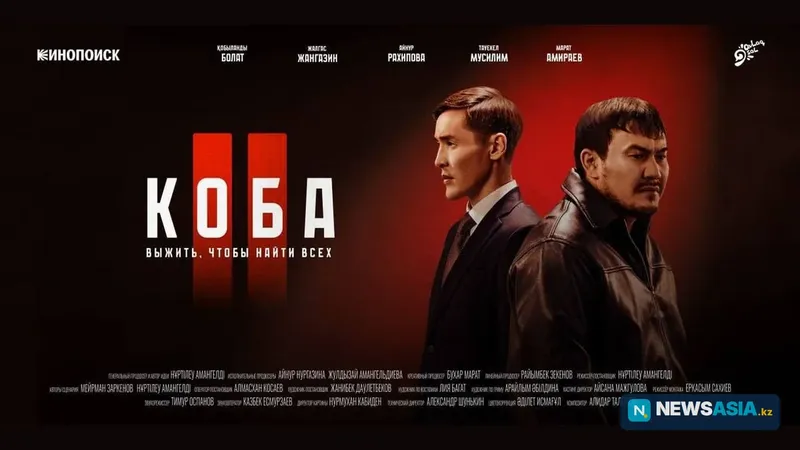
The second season of the crime drama KOBA II premiered on Kinopoisk on November 26. In 2025, the first season of the domestic series entered the platform's top 10 from its first days of streaming. Read about the project and how its sequel was created in a review by NewsAsia.kz, citing NUR.KZ, which published Yandex's interview with the filmmaker.
How the Project Came Together: From a Grocery Trip to Securing Funding
The story of the drama series began with an ordinary everyday moment. The creator aimed to deliver an honest portrayal of law enforcement officers without romanticizing crime, while also proving the concept's viability before major negotiations.
"The idea for KOBA came about in a very routine way. I went to the store to get milk, saw a black car, and thought: what if I got into it right now and drove off to handle some business—what kind of business? I would probably be an operative. And I would have colleagues; there would be four of us. That is how it all started," he recalled.
Securing the budget took a long time, as investors in the Kazakh media market traditionally favor feature-length films. The turning point was a meeting with an investor who believed in the creator's potential without standard formalities.
"I searched for money for two years and didn't know what to do anymore. Then, at one meeting, after ten minutes, an investor said: 'I am not investing in the project—I am investing in you.' It was just like in the movie The Pursuit of Happyness. I pitched like I had never pitched before, without a polished presentation. Sitting opposite me was a man dressed very simply; it shattered my stereotype that an investor must drive a Rolls-Royce. I think what won him over was that I was not afraid of taking responsibility for that amount of money," he said.
Nurtleu Amangeldi: Personal Loss and Directorial Debut
Project creator Nurtleu Amangeldi had no formal filmmaking education. A culturologist by training, he worked for a long time as an information support producer, and in 2022 served as an adviser to the Minister of Culture. While his friend Nurzhan Yerkinuly directed the first season, Amangeldi stepped behind the camera himself for the second season.
"My father was a retired Ministry of Internal Affairs officer. We had one television at home, and police series were constantly on—we watched them as a family. There were three brothers. The youngest was studying to become a director—I insisted on it because he was passionate about videography, and I thought that since I was producing, I could later promote him. I shot the pilot in 2023. We named one of the characters Makha, a name similar to my father's. In 2024, my brother suddenly died of an illness, and three months later, my father passed away. For nearly another year, I could not find funding," he said.
The loss of loved ones turned the work on the series into a matter of honor and helped the creator navigate the most difficult period of his life.
"I didn't state anywhere that I was dedicating the project to them. But when I, as the producer, also became the director, and the story itself is about detectives and my father's life, I realized this project belonged to them. Finishing what they didn't have time to do fell onto my shoulders. It was the only way to avoid falling into severe depression," the filmmaker said.
The series creator also emphasized that the plot is drawn from real observations and aims to rethink the familiar street aesthetics of the 1990s and 2000s.
"I grew up in a city where crime was always close by. I didn't participate in it, but I saw how everything worked. And I didn't want to romanticize it. On the contrary, I wanted to strip crime of its symbols—the leather jacket, the black car—and give them to the detectives. I wanted to break the association: four guys in a black car are not necessarily criminals; they could be law enforcers," he said.
Taking the director's chair for the second season, Amangeldi brought certified professionals on board and refreshed the creative team.
"We kept the structure and the spirit—the leather jackets remained. We changed the cast and part of the crew, and I invited debut cinematographer Almaskhan Kossayev," the director said.
The release of the crime drama's sequel highlights how diverse paths to cinema and creative realization can be. For some, creating a series is a professional challenge and a step toward a franchise, while others find in filmmaking an opportunity to honor family memory and remain true to their principles.

Comments
No comments yet. Be the first.