Fate of the Merkits: From the Selenga Valley to Genghis Khan
In a historical feature, researchers detailed the chronicle of the Merkits, a nomadic people who resisted the empire of Genghis Khan, NewsAsia.kz reports, citing El.kz.
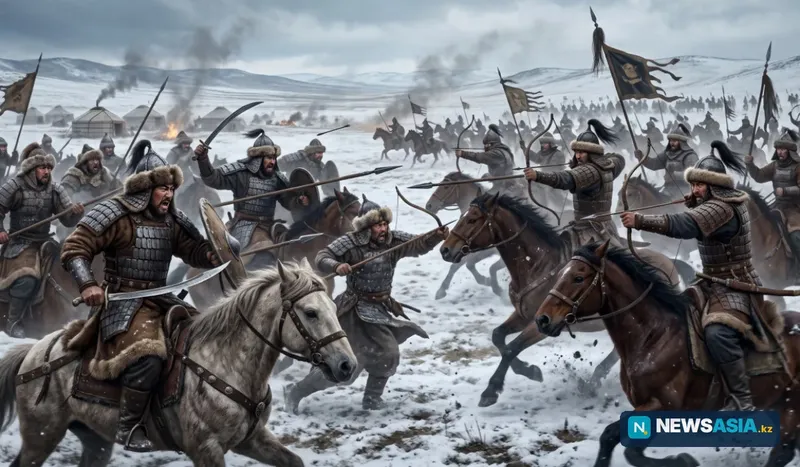
In a historical feature, researchers presented a detailed chronicle of the Merkits, a nomadic people whose fate was inextricably linked to the rise of the Mongol Empire. NewsAsia.kz recounts the dramatic history of the tribe's resistance and its legacy, citing El.kz.
Origins and Settlement in the Selenga Basin
The Merkits roamed the vast lands of the Selenga basin and the lower Orkhon River—territories that today comprise southern Buryatia and Mongolia's Selenge Province. Historical records show that the people were divided into three separate groups. Each wing was headed by its own leader, as the nomads did not elect a single supreme ruler. The linguistic and ethnic affiliation of the tribe has long spurred scholarly debate. Yakut researcher Vasily Ushnitsky links the roots of the Merkits to the Mohe, the ancient inhabitants of Transbaikalia and the Amur region who experienced strong Turkic and later Mongolic influence. The scholar emphasized that virtually no fundamental academic publications on the Merkits had appeared, aside from a popular science book by A. V. Tivanenko published in 1992.
Feud with Temujin and the Abduction of Borte
The long-standing rivalry began long before Temujin was proclaimed supreme ruler. The future khan's father, Yesugei, forcibly took Hoelun from the Merkit warrior Chiledu as he was escorting his young bride home. The nomads harbored the memory of this grievance, and years later launched a swift attack on the camp of the grown Temujin. The tribe's warriors captured his wife, Borte. To rescue his wife, Temujin formed an alliance with Toghrul, the ruler of the Kereits, and his sworn brother Jamukha. The combined forces crushed the Merkit camp on the Selenga River. Borte was returned to her husband, and soon gave birth to Jochi, whose paternity provoked controversy at the ruler's court. Modern historians reconstruct these events using "The Secret History of the Mongols" and the writings of Rashid al-Din, although both sources were produced by the victors, leaving the motives of the defeated to be pieced together from indirect evidence.
Fall of the Army and the End of the War
Following a series of defeats, chieftain Toqtoa-beki retreated to the foothills of the Altai Mountains. In the upper reaches of the Irtysh River, he joined forces with the Naiman leader Kuchlug. However, during another clash with Genghis Khan's forces, the Merkit chief was killed by a stray arrow. Fleeing allied detachments attempted to cross the Irtysh, but most of the warriors drowned in its waters. Earlier, a group of Merkit captives staged an armed uprising in the Taikal tract; Genghis Khan dispatched commander Chimbay, son of Sorqan-Shira, to quell them. The final defeat of the remaining Merkit detachments was dealt in 1216 by the armies of Subutai and Jochi, whose own birth had once been intertwined with the Merkits through his mother's family drama.
Merkit Khatuns at the Court of the Great Khans
The destinies of Merkit women were closely intertwined with the empire's elite. Qulan, daughter of ruler Dair-Usun, became one of Genghis Khan's favored wives and accompanied the conqueror on his campaign into the lands of Khwarezm. An even greater political stature was attained by Toregene, also known as Turakina. She had previously been the wife of Qudu, the eldest son of Toqtoa-beki, and after the defeat of her people was given to Genghis Khan's son Ogodei. Following the Great Khan's death, she assumed the regency of the vast empire in 1241 and succeeded in securing the election of her son Guyuk as ruler. The historical trajectory of these steppe khatuns is analyzed in detail by Vasily Ushnitsky, drawing on studies by Kazakh orientalist Tursun Sultanov and his collaborative work with Sergei Klyashtorny, "Kazakhstan: A Chronicle of Three Millennia."
Legacy and Descendants of the Ancient Clan
Today, memory of the ancient nomads survives across several regions. In Buryatia, population geneticists trace their lineage among the Khori-Buryats using Y-chromosome data. In modern Mongolia, Merkit groups gradually dissolved entirely among local clans. The clearest legacy remains in Kazakhstan, where the Merkits were integrated into the tribal structure as a distinct clan with its own internal lineage.
The history of the Merkits demonstrates how varied the fates of steppe societies could be during pivotal historical eras. For some, they remained the implacable foes of the great conqueror, while others found in their descendants an enduring part of their rich culture and identity.



Comments
No comments yet. Be the first.