Cave-ins, lack of funds and seismic risks: How Almaty built its metro over 23 years
The Almaty Metro, which now carries around 100,000 passengers daily, took from 1988 to 2011 to build amid financial shortages and debates among scientists, NewsAsia.kz reports, citing Tengrinews.kz.

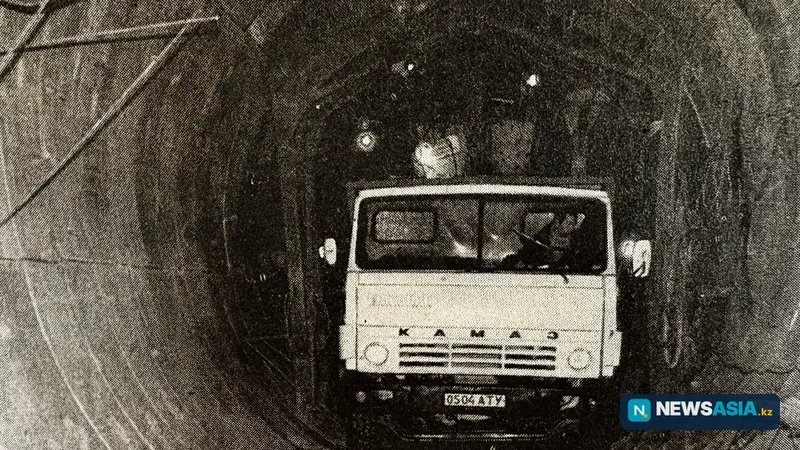
The Almaty Metro, which currently carries around 100,000 people a day and is preparing to build three new stations as well as purchase rolling stock, took 23 years to build. The project was plagued by regular wage arrears to workers, a lack of budget funding, ground collapses, and threats of mothballing, NewsAsia.kz reports, citing Tengrinews.kz.
Rapid transit was first included in the general development plan of Almaty back in 1970. In 1975, specialists were developing a magnetic levitation passenger train, with tracks planned along Sain Street and Abay Avenue. However, the idea was quickly abandoned. An archived July 1997 issue of the Kazakhstanskaya Pravda newspaper outlined the reasons for shutting down the experiment:
"The lack of necessary funding and scientific base took their toll... Another reason that stood in the way of Kazakhstan's 'maglev' was the seismic danger. For the new transit to be truly high-speed, it had to be separated from intersections and traffic lights, that is, elevated above ground. However, the overpass structure proved to be very dangerous seismically."
Due to the earthquake threat and the high cost of multi-level junctions, plans for a high-speed tram along Tole Bi Street were also rejected. Ultimately, the construction of a conventional underground subway was approved in 1982, the metro construction base was established by 1986, and on September 7, 1988, excavation began at the first station, Oktyabrskaya (now Raiymbek Batyr). The first phase was intended to be commissioned by 1997, but the post-1991 economic crisis halted the process.
"The collapse of the USSR in 1991 and the subsequent disruption of economic and trade ties prevented the full realization of the Almaty metro construction. Many issues remained unresolved due to the liquidation of a number of ministries and agencies. And this led to significant delays in deadlines..." the subway's official portal notes.
By 1994, annual construction funding had been slashed to 15–20 percent of actual needs. At that time, a fierce debate erupted in the press regarding the safety of underground structures: V. I. Shchatsilov, a scientist from the Institute of Seismology, called the metro construction dangerous. In response, Pavel Yaremak, technical director of JSC Almatymetrostroy, said in an interview with the press that the project had been revised:
"In 1992, at a technical meeting of an independent expert commission on earthquake resistance assessment, a new station design was reviewed and adopted. The commission, which included V. I. Shchatsilov, concluded that construction was possible, taking into account the seismologists' recommendations. Shchatsilov's signature is also on the conclusion. Two years later, he publicly claims that building a metro in Almaty is a 'crime.'"
As the specialist explained, tunneling faces remained idle during the 1990s due to a total lack of funding, and only emergency crews were on duty underground. The first passengers were able to enter the stations only in December 2011.


Comments
No comments yet. Be the first.